
News Summary
As Hurricane Erin approaches, North Carolina’s Outer Banks is grappling with severe beach erosion and home collapses. In Rodanthe, two homes are at risk of falling into the ocean, part of a troubling trend where 11 homes have been lost since 2020 due to ongoing erosion fueled by climate change. With the storm prompting mandatory evacuations and highlighting the vulnerability of coastal properties, local experts urge for urgent protective measures to mitigate these challenges.
North Carolina’s Outer Banks Experience Dangerous Erosion and Home Collapses as Hurricane Erin Approaches
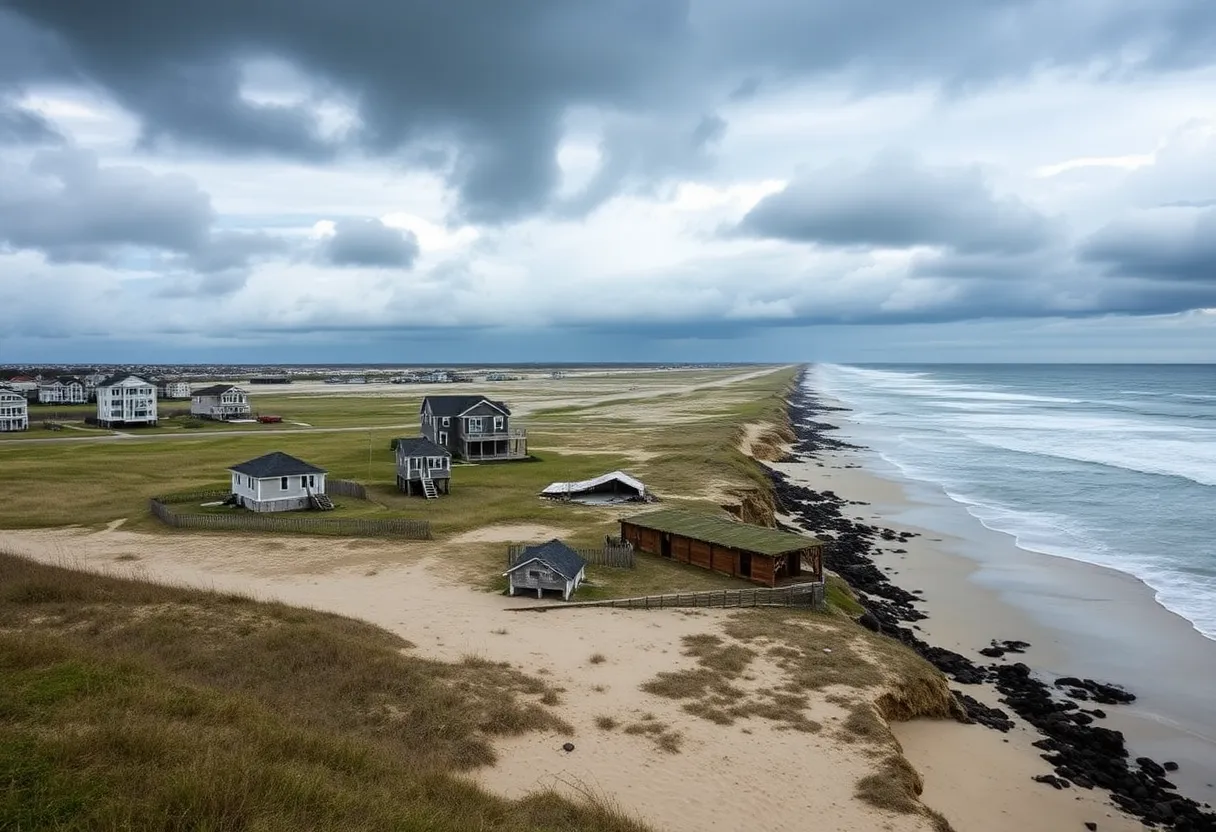
The scenery of North Carolina’s Outer Banks, with its breathtaking beaches and charming communities, is unfortunately facing a **serious threat** as Hurricane Erin draws near. Residents are on high alert as **two homes** become precariously close to falling into the Atlantic Ocean due to the hurricane’s anticipated **high waves** and storm surge. This situation has a larger context, especially since the area has seen **11 homes** in Rodanthe succumb to the relentless ocean since 2020, all a consequence of beach erosion and the increasing impacts of climate change.
Rodanthe at the Edge
Rodanthe, a picturesque village that extends further into the Atlantic than any other part of North Carolina, is particularly vulnerable. Residents like **Jan Richards** and **Maggie Ford** have openly shared their concerns, documenting the precarious conditions of homes during periods of **high tide**. The warning is serious—over the last five years, data reveals that **the National Park Service** has confirmed that at least **11 homes** in Rodanthe have collapsed into the sea.
The Nature of Barrier Islands
Experts point out that barrier islands such as the Outer Banks were not historically considered suitable for construction. These areas are dynamic and ever-changing. Reflecting on past decisions, **David Hallac**, who oversees the Cape Hatteras National Seashore, noted that homes built today are significantly less mobile than the ones constructed decades ago. A historical case in point is the **Cape Hatteras Lighthouse**, which was relocated over half a mile inland due to persistent erosion challenges.
Understanding Erosion Rates
Erosion rates can be alarming, with some sections of the Outer Banks witnessing a loss of up to **10 to 15 feet** of beach per year. As Hurricane Erin approaches, the force of ocean waves is posing an imminent threat to the wooden pilings supporting homes in the area. If any structures collapse, the resulting debris can cause significant environmental risks along the shore.
Currently, out of about **8,800 oceanfront properties** along the entirety of North Carolina’s coast, approximately **750** are already at risk from coastal erosion.
Possible Solutions and Challenges
In light of ongoing erosion, possible solutions have been floated, including the option of hauling in dredged sand or even buying out at-risk properties. However, these solutions face **financial hurdles**, making it challenging to implement effective change. The **North Carolina Coastal Federation** has also highlighted that these erosion threats are not confined to North Carolina; similar issues are cropping up along coastlines in states like California.
Storm Preparations and Evacuations
With Hurricane Erin’s approach, parts of the Outer Banks have entered a **state of emergency**, with mandatory evacuations taking place as residents prepare for the storm surge and **destructive waves**. Evacuations from **Ocracoke Island** alone have moved over **2,200** people and **1,100** vehicles as precautions ramp up. Traffic disruptions are apparent along **Highway 12**, where sections of the road have been compromised by floodwaters and sand debris.
Climate Change and Future Concerns
The impacts of climate change are further exacerbating these issues. Rapid shoreline changes and extreme storm conditions are becoming more common. Experts have voiced that the Outer Banks and similar barrier islands are especially susceptible to storm surges and erosion due to their unique geographic characteristics. Efforts to build protective dunes or carry out beach renourishment are struggling to keep pace with this ever-evolving coastline. Amid mounting risks from ocean conditions and climate change, residents and officials are left to ponder the long-term sustainability of development in this vulnerable area.
FAQ
What caused the homes in Rodanthe to fall into the ocean?
The homes in Rodanthe have been affected by severe beach erosion exacerbated by climate change, leading to their foundations being unstable and eventually collapsing into the Atlantic Ocean.
What are the effects of Hurricane Erin on the Outer Banks?
Hurricane Erin is expected to bring high waves and storm surge, threatening existing structures, causing hazardous swimming conditions, and prompting evacuations across the Outer Banks.
What measures are being discussed to protect the Outer Banks from erosion?
Possible solutions include hauling in dredged sand, buying out threatened properties, and developing infrastructure like protective dunes. However, financial challenges often hinder their implementation.
Key Features of the Story
| Feature | Details |
|---|---|
| Location | North Carolina’s Outer Banks, particularly Rodanthe |
| Key Issue | Severe erosion and home collapses due to climate change and Hurricane Erin |
| Statistics | Approx. 750 out of 8,800 oceanfront structures at risk; 11 homes collapsed since 2020 |
| Storm Impact | High waves, storm surge, mandatory evacuations, and disrupted traffic |
| Potential Solutions | Dredged sand, property buyouts, protective dunes |
Deeper Dive: News & Info About This Topic
- BBC News
- Wikipedia: Hurricane Erin
- New York Times
- Google Search: Hurricane Erin Outer Banks
- CNN
- Google Scholar: Hurricane Erin
- WRAL
- Encyclopedia Britannica: Outer Banks
- USA Today
- Google News: Hurricane Erin


Author: STAFF HERE MYRTLE BEACH
The HERE Myrtle Beach Staff Writers are a collaborative team of journalists, editors, and local contributors passionate about delivering accurate, timely information to the Myrtle Beach community. As part of the HEREcity.com Network, which powers over 100 U.S. city sites including HEREcolumbia.com, our staff draws on collective experience in South Carolina journalism to cover everything from business sales and real estate developments to dining deals and community initiatives. Our Expertise and Background Local Roots in Myrtle Beach Our team includes lifelong Myrtle Beach residents and SC natives with deep knowledge of the area’s history, economy, and culture. We’ve covered key events like the recent developments along the Grand Strand, Myrtle Beach’s tourism and hospitality industry, and growth in local education sectors (e.g., Coastal Carolina University programs). Collective Experience With over 50 combined years in journalism, our staff has backgrounds in print, digital media, and community reporting. We prioritize fact-based stories, drawing from sources like the Myrtle Beach Area Chamber of Commerce, city government records, and on-the-ground interviews. Commitment to Quality Every article is a group effort, involving research, editing, and verification to ensure reliability. We adhere to journalistic standards, citing credible sources and updating content as new details emerge.