

News Summary
The Trump administration is considering forming a Domestic Civil Disturbance Quick Reaction Force comprised of National Guard troops to address civil unrest. This initiative aims to maintain a rapid response team ready for protests in various cities. Meanwhile, a legal challenge arises from California Governor Gavin Newsom, who argues the deployment of troops violates the Posse Comitatus Act. With ongoing trials and differing interpretations of military involvement in domestic affairs, the situation highlights significant implications for federal actions.
Trump Administration Considers National Guard Quick Reaction Force for Domestic Protests
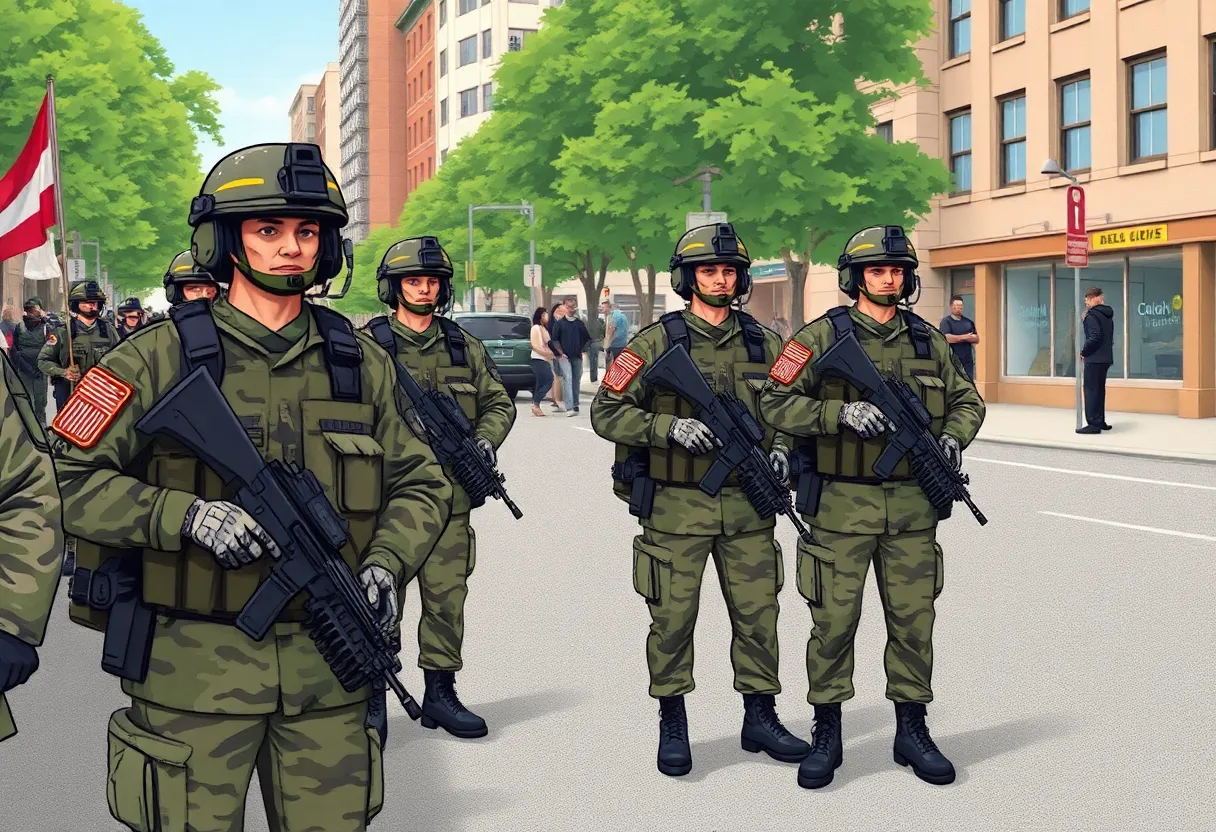
The Trump administration is weighing the idea of forming a Domestic Civil Disturbance Quick Reaction Force made up of hundreds of National Guard troops. This initiative would keep troops on standby around the clock, prepared to respond to any protests or civil unrest that might spark up in cities across America.
Internal documents from the Pentagon that have been reviewed shed some light on this proposed mission. It’s clear that the administration is interested in having a rapid response team on hand, but the implications of this plan raise questions about the scope of military involvement in domestic matters.
Interestingly, while this proposal is under consideration, another legal battle is currently unfolding in a courtroom. California Governor Gavin Newsom has filed a lawsuit against the Trump administration concerning the deployment of approximately 4,000 National Guard troops to Los Angeles amidst protests. Newsom describes this deployment as a blatant “power grab” and argues that it is illegal under the Posse Comitatus Act, a law that restricts the military from enforcing domestic laws.
The Posse Comitatus Act, enacted in the 19th century, ensures that the military cannot act as law enforcement in civilian situations. The Trump administration has defended its actions, claiming that the deployment was crucial for protecting immigration agents and federal properties during the height of protests directed at Immigration and Customs Enforcement (ICE).
In June, Trump referred to the ongoing protests as “a form of rebellion,” which led him to justify the National Guard call-up under Title 10 of U.S. law. This particular title allows the president to mobilize National Guard troops during a situation deemed a “rebellion” or “invasion,” or when enforcement of federal laws is not manageable with standard forces.
Conflicting Interpretations
However, the situation has not been straightforward. Major General Scott Sherman, who was in charge of the Guard task force in Los Angeles, testified that he did not view the protests there as a rebellion. A U.S. District Judge overseeing the lawsuit ruled that the National Guard deployment likely violated the law, but this ruling was later reversed by an appellate court. While the appellate court acknowledged the president’s authority regarding Title 10, it stopped short of defining the protests as a rebellion.
Additionally, Trump has also announced that National Guard troops would assist local police in Washington, D.C., highlighting the unique command framework there, where the D.C. National Guard reports directly to the president. According to Secretary of Defense Pete Hegseth, the Guard will not enact policing duties but may detain individuals temporarily for handover to local law enforcement.
Testimony from Sherman indicates military support could be deployed even without direct threats present. He expressed concerns about questioning loyalty when he raised objections to using military assistance for immigration enforcement in the face of what he perceives to be minimal risks.
This discussion is particularly salient as the operation in Los Angeles has drawn significant attention, showcasing military vehicles and heavily armed officers. A military official confirmed that National Guard members were prohibited from participating in any civil enforcement due to the Posse Comitatus Act.
Troop Deployment and Impact
During the peak of the deployment in June, nearly 5,000 service members, including around 4,000 National Guard troops and 700 Marines, were stationed in Los Angeles. Currently, about 300 Guard members remain active under federal control, focusing primarily on the security of federal buildings.
The legal proceedings continue to unfold, with further discussions on the implications of California’s standing in the case. The outcome could set a significant precedent for the extent to which military forces can engage in domestic matters and how states can respond to federal actions.
FAQs
What is the purpose of the proposed Domestic Civil Disturbance Quick Reaction Force?
The proposed force aims to keep National Guard troops on standby to respond quickly to protests or civil unrest in American cities.
What is the legal challenge surrounding the deployment of National Guard troops?
California Governor Gavin Newsom has filed a lawsuit claiming the deployment of National Guard troops is a power grab and illegal under the Posse Comitatus Act.
What does the Posse Comitatus Act prohibit?
The Posse Comitatus Act prohibits the military from enforcing domestic laws and acting as law enforcement in civilian contexts.
How many troops were deployed in the July protests?
At the peak of deployment in June, nearly 5,000 troops were in Los Angeles, comprising around 4,000 National Guard members and 700 Marines.
Deeper Dive: News & Info About This Topic
- The Hill: Trump Administration Considers National Guard Quick Reaction Force
- The New York Times: Trump National Guard and Lawsuits
- CBS News: General’s Testimony on LA Military Deployment
- Wikipedia: Posse Comitatus Act
- AP News: California’s Lawsuit on National Guard Deployment
- Encyclopedia Britannica: National Guard


Author: STAFF HERE MYRTLE BEACH
The HERE Myrtle Beach Staff Writers are a collaborative team of journalists, editors, and local contributors passionate about delivering accurate, timely information to the Myrtle Beach community. As part of the HEREcity.com Network, which powers over 100 U.S. city sites including HEREcolumbia.com, our staff draws on collective experience in South Carolina journalism to cover everything from business sales and real estate developments to dining deals and community initiatives. Our Expertise and Background Local Roots in Myrtle Beach Our team includes lifelong Myrtle Beach residents and SC natives with deep knowledge of the area’s history, economy, and culture. We’ve covered key events like the recent developments along the Grand Strand, Myrtle Beach’s tourism and hospitality industry, and growth in local education sectors (e.g., Coastal Carolina University programs). Collective Experience With over 50 combined years in journalism, our staff has backgrounds in print, digital media, and community reporting. We prioritize fact-based stories, drawing from sources like the Myrtle Beach Area Chamber of Commerce, city government records, and on-the-ground interviews. Commitment to Quality Every article is a group effort, involving research, editing, and verification to ensure reliability. We adhere to journalistic standards, citing credible sources and updating content as new details emerge.