A new comprehensive guide has been released to assist aspiring hunters in preparing for the 2026 hunting season, outlining critical steps for those new to the sport. The resource emphasizes the importance of education, proper licensing, and adherence to safety standards, offering a detailed roadmap for individuals looking to engage in ethical and responsible hunting practices.
Central to the guide’s recommendations is the completion of a state-approved hunter education course. These courses are designed to equip new participants with fundamental knowledge and skills necessary for safe and legal hunting. Options for completing these requirements typically include traditional classroom instruction, often supplemented with a practical field day, or online coursework that may also require an in-person field day. In some states, adult learners may even find fully online options available. The curriculum for these courses is broad, covering essential topics such as firearm and archery safety, principles of fair chase, accurate wildlife identification, establishing safe zones of fire, wilderness survival techniques, basic first aid, and a thorough review of local hunting regulations.
Navigating the regulatory landscape is another key component highlighted by the guide. Hunting licenses, specific season dates, legal weapon types, minimum caliber or draw weight requirements, and bag limits are highly variable. These regulations can differ significantly by state, specific game unit, species, and even by the type of weapon used or the animal’s sex or age. For high-demand hunts, participation may necessitate applying through a lottery system, while tags for other species might be readily available over the counter. Hunters are advised to meticulously research and understand the specific requirements for their intended hunting area, ensuring all necessary licenses and species tags are secured well in advance of opening day. This careful planning also extends to securing legal hunting access, whether on public lands or through private land permissions.
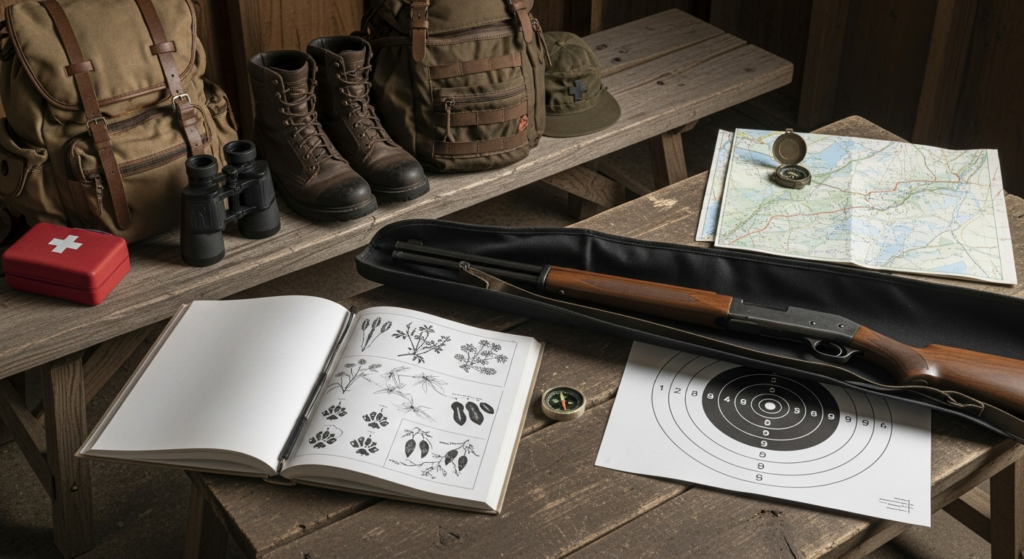
Equipping oneself properly is paramount, and the guide provides a detailed list of recommended basic gear. This includes a legal weapon—such as a rifle, shotgun, or compound bow—along with appropriate ammunition or arrows. Practice equipment is also suggested to ensure proficiency before entering the field. Beyond the weapon, essential items include all required licenses and tags, hunter orange clothing where mandated for visibility, and broken-in waterproof boots for comfort and protection. Layered, non-cotton clothing is recommended for adaptability to changing weather conditions. Other crucial tools comprise binoculars for scouting, a day pack for carrying essentials, sufficient water and high-calorie snacks, a headlamp with extra batteries for low-light conditions, a sharp knife, and a comprehensive first-aid kit. The guide also provides approximate cost ranges for entry-level gear, estimating $450–$800 for a basic rifle and scope, $350–700 for a deer or small-game shotgun, and $400–900 for a compound bow package. Additional costs for boots and basic clothing layers are estimated at $200–400, with entry-level binoculars ranging from $100–250.
Safety remains a central theme, with the guide emphasizing four fundamental firearm safety rules: treating every firearm as if it were loaded, always keeping the muzzle pointed in a safe direction, keeping the trigger finger off the trigger until ready to shoot, and positively identifying the target and what lies in front of and beyond it. For those engaging in elevated hunting from tree stands, additional safety measures are critical. These include the use of a full-body safety harness, a lineman’s belt for climbing, a lifeline for continuous attachment, thorough inspection of the stand before each use, and a haul line for safely raising and lowering unloaded weapons.
After a shot has been taken, the guide provides clear instructions for responsible follow-up. Hunters are advised to carefully observe the animal’s reaction and mark its last known location. Depending on the animal’s behavior, a waiting period may be appropriate before beginning the tracking process. Tracking should commence at the hit site, slowly following any signs such as blood trails or disturbed vegetation. If tracking becomes difficult, seeking assistance from experienced individuals is recommended. Once the animal is recovered, it must be tagged as required by state regulations. Prompt cooling and cleaning of the meat are essential for preservation, and hunters must adhere to all state rules regarding carcass or quarter transport.
Why it matters in Myrtle Beach
For residents of Myrtle Beach and the broader Horry County area, understanding responsible hunting practices is pertinent given the region’s proximity to diverse natural habitats and the Waccamaw River watershed, which supports various game species. As summer progresses and outdoor enthusiasts plan for fall activities, this guide underscores the importance of safety and adherence to regulations for anyone considering hunting. The Horry County Government, a major employer in the area, prioritizes public safety and responsible outdoor recreation, aligning with the guide’s emphasis on education and ethical conduct. Ensuring new hunters are well-prepared helps maintain safety for all outdoor users and preserves the natural resources that contribute to the quality of life in Myrtle Beach. This information is crucial for fostering a safe and informed community of outdoor participants. It also reinforces the need for local residents to be aware of and respect the diverse recreational activities that take place across the Grand Strand region. This commitment to safety and responsible engagement benefits the entire community, from those directly involved in hunting to others who enjoy the area’s natural beauty.