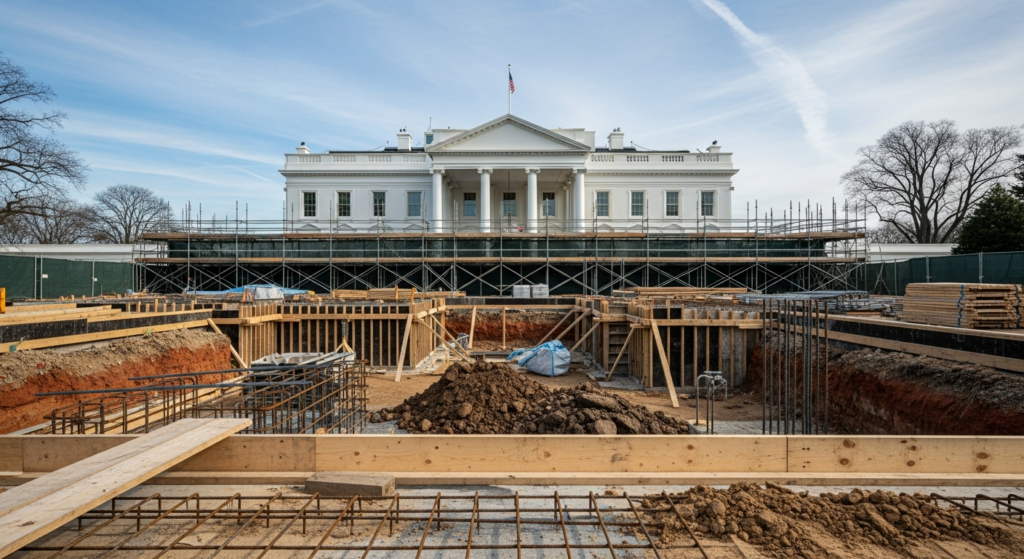
A federal appeals court has delivered a significant blow to the Trump administration’s plans for a sprawling new ballroom at the White House, ruling that the ambitious $400 million project cannot proceed without explicit approval from Congress. The U.S. Court of Appeals for the District of Columbia Circuit issued a 2-1 decision, halting aboveground construction of the proposed 90,000-square-foot facility.
The ruling, handed down by a three-judge panel, found that President Donald Trump lacked the unilateral authority to build the extensive ballroom on the site of the recently demolished East Wing. The court emphasized that such a substantial undertaking, particularly one involving federal property and significant public funds, falls under the purview of legislative authorization.
Judges Patricia Millett and Bradley Garcia formed the majority in the decision. Judge Millett was nominated to the appeals court by former President Barack Obama, while Judge Garcia was a nominee of President Joe Biden. Their joint opinion underscored the principle of checks and balances, asserting that the executive branch must adhere to congressional oversight for major construction projects of this nature. Dissenting from the majority was Judge Neomi Rao, a nominee of President Trump, who argued against the court’s intervention in the administration’s plans.
The court has temporarily stayed its ruling for 14 days, providing the administration with an opportunity to appeal the decision to the U.S. Supreme Court. This period allows for a potential last-ditch effort to overturn the appeals court’s order and resume the project as initially conceived.
The legal challenge originated in December 2025, when the National Trust for Historic Preservation filed a lawsuit against the administration. This action came approximately one week after the demolition of the White House’s East Wing had been completed, paving the way for the proposed ballroom. The planned facility was designed to accommodate up to 999 people, intended for large-scale official events and state functions.
The ballroom project has been a point of contention between the executive branch and Congress for several months. In May, Congress rejected the administration’s request for $1 billion in funding for the ballroom. Subsequently, in June, Democratic lawmakers raised concerns that $350 million from a recent tax cuts law appeared to have been redirected to finance the project, bypassing congressional appropriations processes. This alleged redirection of funds fueled the legal challenge and highlighted the broader debate over federal spending authority.
It is important to note that the appeals court’s ruling specifically targets aboveground construction. The decision does not prohibit underground work, which includes the development of bunkers, military installations, medical facilities, and other national-security facilities. This distinction suggests that the court’s primary concern was the public and ceremonial nature of the ballroom and the associated expenditure without legislative consent, rather than classified or strategic infrastructure.
The planned project had received its final approval from the 12-member National Capital Planning Commission on April 2, prior to the legal challenge gaining traction. The Commission, responsible for planning and development in the federal capital region, had given its green light, but the subsequent judicial review has now overridden that administrative approval, at least for the aboveground components.
The implications of this ruling extend beyond the immediate fate of the White House ballroom. It reinforces the judiciary’s role in scrutinizing executive actions, particularly those involving significant federal expenditures and alterations to national landmarks. The decision underscores the constitutional requirement for congressional authorization of major federal projects, ensuring that taxpayer dollars are allocated and spent in accordance with legislative intent.
Why it matters in Myrtle Beach
The federal appeals court’s decision to halt the White House ballroom construction carries a broader significance for communities across the nation, including Myrtle Beach. The ruling reinforces the principle of congressional oversight over federal spending and executive power, a dynamic that directly impacts the flow of federal resources to Horry County. U.S. Representative Russell Fry, who represents South Carolina’s 7th Congressional District, and U.S. Senator Lindsey Graham are key figures in advocating for federal appropriations that support local infrastructure, healthcare, education, and economic development initiatives in Myrtle Beach. The court’s insistence on proper authorization ensures that federal funds, whether for national projects or local grants, are managed with accountability and transparency. This precedent can influence how future federal projects are conceived and funded, potentially affecting the availability and allocation of resources that benefit the residents and institutions of Myrtle Beach, from the Horry County School District to the Grand Strand Regional Medical Center.