Editor’s Disclosure
HEREMyrtleBeach.com is published by HERECity Network, an independent local news organization. Your Indoor Golf Solutions, the subject of this article, has a business relationship with HERECity Network as a technology and services partner. This article was reported, written, and edited by a HERE editor to HERECity Network’s editorial standards. Your Indoor Golf Solutions reviewed the article for factual accuracy regarding its own business operations only; editorial judgment and final publication decisions rest with HERECity Network. See our Editorial Standards.
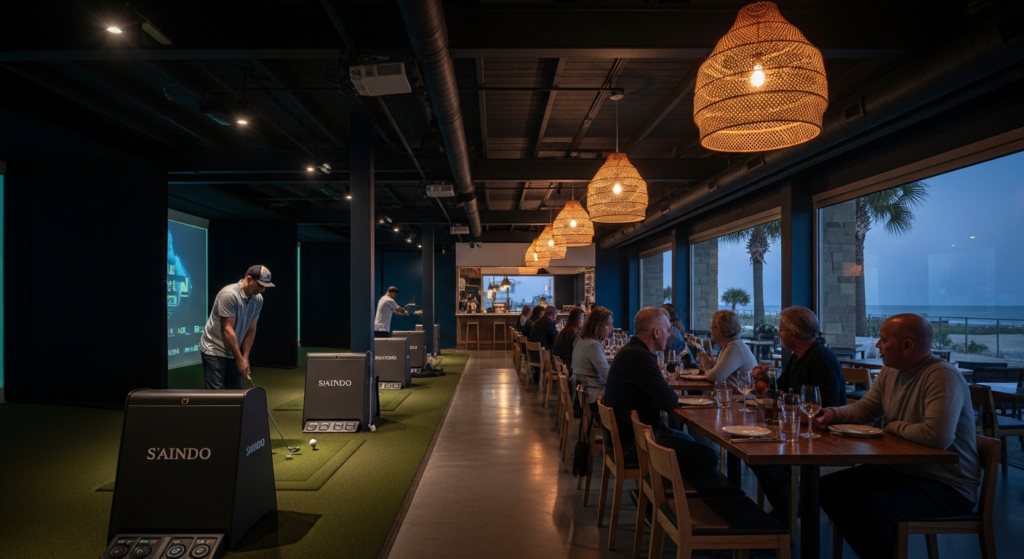
Picture a Myrtle Beach restaurant packed with tourists on a rain-soaked Tuesday, half of them golf trip regulars who booked their whole vacation around tee times that just got scrapped. That’s the exact scenario a growing number of South Carolina restaurant operators are trying to solve with a technology upgrade instead of a weather app.
The trend isn’t unique to the coast, but it fits especially well here. Nationally, commercial simulator venues have nearly tripled since 2022 to more than 1,500 locations, according to the National Golf Foundation, and food-and-beverage attach rates are a major reason why. RG Golf’s 2026 analysis found that 30% to 40% of total revenue at national chains like X-Golf and Five Iron Golf comes from food and beverage sales, with alcohol especially profitable — a formula that translates directly to a market built around dining, drinking, and golf tourism all at once.
For operators across the state — not just in tourist-heavy Myrtle Beach but in college towns and mid-size cities alike — the appeal of a golf bay isn’t the novelty. It’s the ability to keep tee-time-driven customers spending money on a rain day instead of driving to another town’s arcade.
Why South Carolina is a natural fit
South Carolina’s restaurant and hospitality economy already leans heavily on golf tourism, particularly along the coast, which means the customer base for a simulator bay essentially already exists — it just needs somewhere to go when the outdoor course closes for weather. Operators nationwide have found that pairing a bay with an existing kitchen and bar captures that demand without requiring a brand-new standalone business.
The economics support the bet. Golf O’Clock’s dataset across 200-plus venues shows a single bay at 60% utilization and a $50-per-hour rate producing $4,000 to $5,500 a month in simulator revenue alone, climbing to $6,000 to $8,000 once food and beverage revenue attaches — money that shows up regardless of forecast.
A faster payback than most renovations
What makes this pencil out for a restaurant owner, rather than just a standalone entertainment venue, is speed of return. Golf Sim Masters estimates payback for a bar-attached bay at 3 to 8 months once F&B uplift is included — a return window most kitchen or dining-room renovations simply can’t match.
Startup costs remain the real gating factor for many operators. RG Golf puts an all-in single-bay build at $50,000 to $150,000, and Attractions Marketing Pros notes that equipment financing can reduce upfront capital needs by 40% to 50% — a detail that matters for restaurant owners weighing a bay addition against other capital priorities.
Getting the pitch right for a coastal market
Not every restaurant layout supports a bay the same way. Waterfront properties, tourist-heavy dining rooms, and space-constrained downtown spots each present different tradeoffs around ceiling height, sightlines, and how a bay affects existing seating capacity during peak season.
That’s a scoping conversation worth having before signing a contractor, not after — which is why operators considering the move are increasingly told to call a dedicated consultant first rather than a general contractor.
A statewide opportunity, not just a coastal one
While the tourist-driven rain-day logic is easiest to see in a market like Myrtle Beach, the same math applies broadly across South Carolina. College towns with weeknight bar traffic, mid-size cities with underused restaurant square footage, and suburban dining corridors all share the same basic opportunity: an existing food and beverage business with room to add a revenue stream that doesn’t depend on the weather.
Nationally, well-run six-bay facilities post 15% to 25% profit margins on $500,000 to $900,000 in revenue, according to Attractions Marketing Pros, and Golf O’Clock’s broader venue data shows a range of 15% to 35% depending on the operating model — evidence that the format works across a range of business sizes, not just large-format flagship venues.
Local Sports Lens
Your Indoor Golf Solutions, PGA Pro-owned by Greg Sheffield, has spent 25 years installing indoor golf simulators for homes, businesses, restaurants, and bars. The company works with clients nationwide — including South Carolina — and provides consulting on which technology tier, space configuration, and F&B integration makes sense for a given venue. Businesses considering a simulator install can request a consultation at (309) 826-0439 or via the HERE partner page.
The rainy Tuesday that used to be a lost night for a Myrtle Beach restaurant doesn’t have to stay lost. Increasingly, it’s just a different kind of tee time.