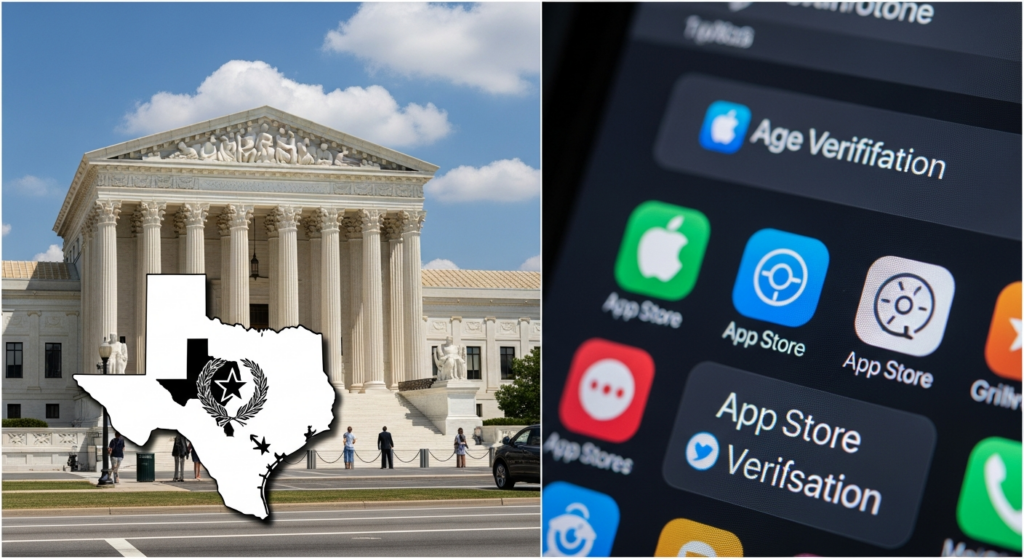
The Supreme Court has allowed a Texas law mandating age verification for app store users to take effect, even as legal challenges against the statute continue. The decision, issued on Friday, July 10, 2026, means the law, which requires app stores to implement age checks for minors, will remain in force while its constitutionality is debated in lower courts.
The Texas law focuses on app-store duties, placing the onus on digital platforms to ensure that users are of appropriate age before accessing certain content or applications. Independent legal analyses and national reporting describe the legislation as a measure designed to protect minors by restricting their access to potentially harmful material online through age verification mechanisms. The specifics of how these age checks are to be implemented and enforced are central to the ongoing legal disputes.
While the Supreme Court’s action is not a final ruling on the merits of the law, it signals that the court sees no immediate reason to halt its implementation during the appeals process. This development could influence legislative efforts in other states considering similar digital age-verification requirements. For residents of Myrtle Beach, particularly parents and educators, the evolving landscape of online content regulation for minors is a subject of increasing attention.
The legal battle surrounding the Texas law highlights broader questions about digital privacy, parental control, and the responsibilities of technology companies. As the case progresses through the courts, further updates are expected to clarify the scope and enforceability of such regulations. Families in Myrtle Beach are encouraged to monitor confirmed legal updates and consult qualified local parent or legal resources for information relevant to their specific circumstances.
### Why it matters in Myrtle Beach
The Supreme Court’s decision, while originating in Texas, carries potential implications for families and educational institutions across the country, including in Myrtle Beach. The Horry County School District, which serves thousands of students, and Coastal Carolina University, with its large student body, both navigate the complexities of digital access and online safety for minors and young adults daily. Should similar legislation be considered or enacted in South Carolina, it could impact how students access educational apps, how parents manage their children’s digital environments, and the broader digital literacy initiatives within schools. The ongoing legal debate underscores the evolving challenges of regulating online spaces to protect minors, a concern shared by parents and educators throughout the Myrtle Beach area.